


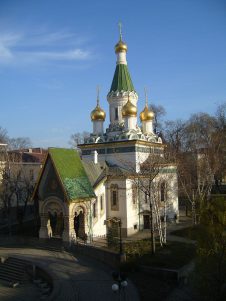
Russian Church
The Central Military Club in Sofia is among the masterpieces of the Bulgarian early 20th-century architecture, which still adorns the city centre of Bulgaria’s capital city. It is one of the earliest monumental buildings erected after the re-establishment of the Bulgarian state after centuries of Ottoman government.
The Central Military Club is located in the center of Sofia, on the crossroad of the popular Tsar Osvoboditel Blvd. (covered by its characteristic yellow pavement) and Rakovska Str.. It is right opposite of the Crystal Garden and the Russian Church of St Nikolay.
The Military Club was designed by Czech architect Antonín Kolář in the Neo-Renaissance style and finished by Bulgarian architect Nikola Lazarov in 1907. The lot and the funding was provided by the Sofia Officers’ Assembly. That is why the building was initially known as the Officer’s Club and its halls were used for receptions, festivities, balls and various events of the nascent capital’s elite, a larger part of which belonged exactly to the military class.
It consists of two wings and tree monumental towers, whose facades are entirely covered by rich plastic decoration: elegant terraces, elaborate columns, windows adorned by triangular frontons etc. – a rich Renaissance palette of Neo-Classic architectural elements. The building has three stories and features a coffeehouse, an art gallery, a number of refined halls varying in size, as well as an imposing concert hall with ca[acoty of up to 450 specttors. Due to all this, the Central Military Club has always been an important cultural centre of the capital. As part of the city’s beautification project, the facade of this attractive, Renaissance-style building was refurbished a few years ago.
Central Military Club
The Central Military Club (Bulgarian: Централен военен клуб, Tsentralen voenen klub) is a multi-purpose monument of culture building in the centre of Sofia, the capital of Bulgaria, located on Tsar Osvoboditel Boulevard and Georgi Rakovski Street. It serves the Bulgarian Army and is administered by the Executive Agency of Military Clubs and Information. The 2010 world chess championship match between Viswanathan Anand of India and Vaselin Topalov of Bulgaria was held in this building that was won by Viswanathan Anand.
The foundation stone of the edifice was laid in 1895. The Military Club was designed by Czech architect Antonín Kolář in the Neo-Renaissance style and finished by Bulgarian architect Nikola Lazarov in 1907. The lot and the funding was provided by the Sofia Officers’ Assembly. A stone from the battlefield at Slivnitsa from the Serbo-Bulgarian War (1885-1886) was laid in the foundations.
The building has three stories and features a coffeehouse, an art gallery, a number of refined halls varying in size, as well as an imposing concert hall with 450 seats. Due to all this, the Central Military Club has always been an important cultural centre of the capital, once exhibiting works by Ivan Mrkvička, Vladimir Dimitrov, Jaroslav Věšín and providing these noted artists with studios. The concert hall has also seen performances by actors and opera singers like Krastyu Sarafov, Nicolai Ghiaurov, Feodor Chaliapin, Boris Christoff, and bands like Ladytron etc.